Sunday, 9 February 2014

Joanne Tatham & Tom O’Sullivan - HK

Joanne Tatham and Tom O’Sullivan work in collaboration to produce provocative and interrogative works that are often concerned with the mythic potential of art.

Utilising sculpture, painting, architecture, performance, literature, institutional critique and curation, the artists re-stage and re-present a vocabulary of images, phrases and forms that are part of a common history to create carefully crafted paths, displacements and diversions.  These act as a tool for exploring the world of art - with its own collective mythology of forms, objects and histories.
http://www.chapter.org/joanne-tatham-and-tom-osullivan-tool-making-signs-1


The Glasgow artist duo Joanne Tatham (born 1971 in West Yorkshire) and Tom O’Sullivan (born 1967 in Norwich), who have worked together since 1995, attracted attention last year in the Tramway exhibition space in Glasgow with their installation "HK“. Six-meter-high black letters formed the three-dimensional slogan "Heroin Kills“, undermined by its monumental nature. Tatham & O’Sullivan, whose works are in the tradition of concept art, are concerned with the questioning of the parameters of art, the investigation of what contemporary art can be and what it can accomplish. The installation "HK“ therefore operated in the realm between purely artistic statement and social reality (given that Glasgow is the British city with the highest rate of heroin addicts). Tatham & O’Sullivan draw their image and form vocabulary from a rich store of existing languages, extending from art history over applied arts, esotericism, and pop music to theater, while their interest is primarily in hyper-encoded and iconic forms. Their installations are however more than merely a sampling of various quotes; they are a clever play on the multireferential nature of the characters employed, not least of all satirically referring to the clichés of installation art. 
http://www.kunsthausglarus.ch/en/frontend/exhibition_detail/318

Heroin kills. Smoking kills. Alcohol kills. These things we know, even as we reach for a dram, a puff or a fix. The odd status of such warnings, these axioms of addiction, is what Joanne Tatham and Tom O'Sullivan explore in an astonishing, epic sculptural installation. Three-dimensional letters, 6m high, stretching right across the vast main space at Tramway, spell out their message (heroin kills) in monumental form, one that is both shocking and playful.

What play there is comes from the references to other famous groups of letters - those that spell out Monty Python and Hollywood, the black letters saying "The Ramones", held by the group in a photograph. It's also about the scale of the piece, and its dour monochrome of white walls and coal-black letters, echoing the atmosphere of those 1980s Don't Die of Ignorance health warnings about HIV that featured tombstones and were lit like a morgue.

But HK is more than smart intertextual references. Our first sight is of the message back to front, and in its stark beauty, with chinks of light spilling through the gaps in the letters, the slogan forms a mirror to Glasgow's vexed relationship with smack. At the heart of one of its key former industrial spaces, we cannot miss the impact of the message; it's a fact of life in the post-industrial reality just beyond the gallery. This is where the shock kicks in.

"Heroin kills" are not the only words in this exhibition, though. Pasted on to noticeboards in the foyer, you will find, in comparatively tiny lettering, testimonies of former addicts and those who are still struggling with addiction. And it's in the space between the two - these sad tales, and the giant, meaninglessly obvious slogan - that Tatham and O'Sullivan's interest lies. Their sculpture suggests that, somewhere between the individual struggle with drugs and the hysteria of much of the media's coverage of heroin, perhaps other words and other stories lie.
Elisabeth Mahoney
http://www.theguardian.com/artanddesign/2001/dec/22/art.artsfeatures 
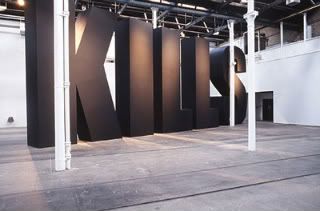
HK began with the exhibition, in 2001, of a phalanx of 11 black, six-metre-high letters spelling out the words ‘Heroin Kills’ at Glasgow’s Tramway. The following year the same words adorned Tatham and O’Sullivan’s HK Necklace (2003), a piece of hand-cut 18-carat gold jewellery worn by an invited selection of high-profile, Venice Biennale-bound artists, art dealers and curators, which the artists then subsequently incorporated into the sculpture HK Necklace with Jester (2003), in which the El Lissitzky-meets-LL Cool J-styled necklace is embraced by a shop-bought Swarovski crystal harlequin; the piece appeared, at the artists’ insistence, on their dealer’s stand at Art Basel 2004.

This set of transpositions is a lot to swallow in a single gulp, so perhaps it’s best to begin by rolling the phrase ‘Heroin Kills’ around our mouths, to get used to its peculiar flavour. While it functions, in a sense, as a warning, it is worryingly unspecific. As Lars Bang Larsen has written: ‘It’s not a slogan but it sounds like one, like “smoking kills”, or “speed kills”. But opacity of meaning succeeds the bombast: how does heroin kill? Does it kill everyone or just a few? Who is telling us? Don’t we know already?’1 We do know, of course (we all saw the ads on TV), and that’s what makes the project so uncomfortable. Uttering ‘Heroin Kills’ in Glasgow, a city with a substantial smack problem, seems glibly after the fact, while uttering it in Venice and Basel, especially in the language of fashion, or of rich men’s fripperies, seems glib full-stop. However, what is in play here, and what is important, is not only the continuous emptying-out of an already empty phrase’s meaning, but also the set of permission-giving discourses that allowed this emptying-out to take place. Among these we might number the New Labour idea of art as a public good (Glasgow), the willingness of art world bigwigs to wear Tatham and O’Sullivan’s heroin-chic bling to glamour-heavy openings, dinners and parties (Venice), and even the art market’s adoption of Jeff Koons as a favoured son, on which HK Necklace with Jester depends for much of its commercial lustre (Basel). Ultimately the project exists not in objects, or even in ideas, but in their traffic with, and misappropriation by, power structures. HK is not subversive, if by that we mean something that comes out of the blue to overturn established meanings. Rather, it is an inside job, an act of faux subversion, and one that pleads for itself as the only type of subversion we have left.
Tom Morton
https://www.frieze.com/issue/article/mirror_mirror/

HK marble (Absolute Black Zimbabwe), 2004

There has been a healthy air of anticipation around Joanne Tatham and Tom O'Sullivan's new Tramway show.

There were the occasional rumours of ''something really big'' going on in what is, after all, the largest gallery space in the country. Then an unusually elegant private-view card, emblazoned with the mysterious letters HK, arrived, along with the information that the pair, who graduated from Glasgow School of Art's master of fine arts course in the mid-nineties, have been working with the controversial issue of drugs. Tatham and O'Sullivan are consistently intriguing artists. Their sculptural works have included references to such diverse subjects as rave culture, amateur craft, eighteenth-century painting, surrealism, sixties minimalism, studio ceramics, and teen movies. Their installation, The Glamour, shown at Transmission Gallery last year and then at the Berlin Biennale, involved barbed wire, pink fluorescent lighting, mirrors, and literally tons of rubble. It's as though they feel quite free to rummage round the skip of art history for anything they can recycle and put to good use. They're not just ragpickers, though, but astute construction workers, putting their pieces together with intelligence and a keen satirical eye for some of the more wearisome cliches of installation art. By forcing these contradictory elements to sit down together in one room, they are constantly begging the questions of whether art is any more than just style, and why it has developed its own language, so divorced from our everyday conversation. Ultimately, they are asking if art and the rest of life can rub along, or if they're destined for a series of misunderstandings, secret admiration, and mutual mistrust. Although all of this had aroused my curiosity, none of it had actually prepared me for the jaw-dropping experience that is HK, an artwork that at first sight is so simple and so audacious it actually made me gasp out loud. The installation starts in the lobby of Tramway, with reading a wall of moving, complex stories, transcribed from interviews with people affected by heroin use, including a user, a drug worker, and a bereaved parent. Entering Tramway 2 you see HK for what it really is: an empty and enormous slogan. The words HEROIN KILLS writ out in three-dimensional black letters, each some six metres high. They tower above you, looking like something from Stonehenge or The Flintstones, something dropped out of the sky like the opening titles of Monty Python's Flying Circus. The words are huge, empty, fatalistic, and indisputably true. HK is physically overwhelming, yet so woefully inadequate a response to the stories relayed outside, that it's almost laughable. Tatham and O'Sullivan know what they're up to. The slogan recalls the government's spectacularly unsuccessful Aids campaign from the 1980s, featuring creaking tombstones and equally creaking logic. And the embarrassing plotline from school soap Grange Hill, where cute and cheerful Zammo became a desperate drug-addled junkie, and the cast made a hit record admonishing schoolchildren across the country to Just Say No. There's art in here, too. The 1980s sloganeering of Jenny Holzer and Barbara Kruger, the cool conceptualism of Lawrence Weiner. The letters are so large that you can walk through them and under them, find yourself nestling under the crossbar of the H, tempted to dive through the centre of the O. It's like seeing one of those immense metal sculptures by Richard Serra, which are so big that when you walk around them you are secretly terrified they're going to fall on you. BUT HK is also kind of thrilling, in a punk, 1970s New York kind of way. You think of Lou Reed's miserable album Berlin, of the writer and addict Alexander Trocchi. You find yourself seduced by the seedy glamour of it all, aware Tatham and O'Sullivan are pushing at the edge, knowingly opening themselves to accusation of triviality and exploitation over such a serious issue. Last week new research showed that 3.8% of Glaswegians between 15 and 54 are misusing hard drugs such as heroin or methadone. There are 2.6million drug-related crimes every year. If it's a commonplace cliche in art that truth is beauty, what do we do when the facts are as ugly, as unconsoling as this? HK isn't going to answer that, but it's an admirably provocative and somewhat bloody-minded contribution to the discussion.
Moira Jeffrey
http://www.heraldscotland.com/sport/spl/aberdeen/staggering-message-writ-large-moira-jeffrey-is-knocked-out-by-a-stunning-installation-which-aims-to-provoke-new-debate-on-the-menace-of-heroin-1.166825

Joanne Tatham and Tom O’Sullivan, Artists from Contemporary Art Society on Vimeo.

Saturday, 8 February 2014

ZINE IDOL @ HMC Micro Cinema, Dundee 08.02.14 - pictures

To Dundee's Hannah Maclure Centre today for Zine Idol, Yuck 'n Yum's contest to find a self-published zine to win support, guidance, and £500 seed money to make their zine dreams a reality. I took a few photos and here they are:


The name of the event is Zine Idol

MC Alexandra holds forth

The judging panel (L-R your correspondent, Andrew, Claire)

CC

http://thecollagecollective.tumblr.com/

Barnum's Baby

http://wevebecomemango.blogspot.co.uk/

Plastik zine

https://www.facebook.com/plastikzine

St.art Magazine

http://www.st-artmagazine.com/

Anti-Zine

http://www.antizine.com/

Big decision: CC are the Zine Idol winners!!!!! Congratulations CC!

http://zineidol.yucknyum.com/

Friday, 7 February 2014

Zazous


The Zazous were a subculture in France during World War II. They were young people expressing their individuality by wearing big or garish clothing (similar to the zoot suit fashion in America a few years before) and dancing wildly to swing jazz and bebop. Men wore large striped lumber jackets, while women wore short skirts, striped stockings and heavy shoes, and often carried umbrellas.
http://en.wikipedia.org/wiki/Zazou


During Nazi occupation of Paris there was a foppish revolt by a group of French youths, (between 13-21 years old, described by the occupiers as J3 age group for rationing and identity card purposes) in a mannered sarcasm first rehearsed by Baudelaire. They were first described as “L’Homme Revolte” by Albert Camus but by 1941 they had named themselves The Zazous, inspired by the Cab Calloways’s Jazz hit from 1933 “Zah Zuh Zah”, which was a part of an overbearing American influence by way of Jazz and Swing that infiltrated French youth culture and ultimately became a substance for which they opposed Nazi rule and particularly Nazi censorship.
The boys wore a dandy uniform with long check coats, high collared shirts and slim trousers with bright socks and had hair “oiled like a salad”, and the girls adorned themselves in suede coats, roll neck sweaters, with their hair tightly rolled to a bun at the front of their heads and made themselves up with scarlet lips and nails. Their culture existed under ground with surprise parties that were highly illegal gatherings where they behaved like obnoxious adolescents and ended the nights by smashing everything up.

They perfected the negative aesthetic and took energy from their enemies, through clever mockery and a sarcastic attitude that symbolized their resistance. This was typified by many of the Zazou wearing a Yellow Star exactly like the one that singled out the Jew except for the detail of the word “Swing” in the middle.
Budding Grove
http://www.examiner.com/article/les-zazous-fashion-nazi-occupied-france 
'Dancing, particularly upon Sundays, had been the rage among young people before the war, but after the Occupa­tion was banned both by Vichy and the Germans. The Germans were wary because such gatherings of young people might cause unrest. Vichy had other reasons: dancing was held to be indecorous when so many Frenchmen had been killed or were languishing in prisoner-of-war camps; it would encourage fraternization with German soldiers; it might promote promiscuity…Nevertheless, in early 1942 the prohibition began to be flouted. Cardinal Gerlier noted with regret that even some Christian families were infringing the ban, which he deplored because 'among all the different forms of recreation, dancing is the one that expresses joy most fully'. There was too much misery abroad and, he added in a reference to the Germans, it was wrong 'to dance under the gaze of those who observe us'.

Those ever-present 'observers' had lifted the ban in the occupied zone for their own troops by mid-1941 but had left the decision regarding French civilians to the Vichy authorities for 'if [they], in spite of the disgraceful defeat of their country, wish to dance, it is in the German interest not to prevent their so doing'. Since Vichy continued the prohibition, many private dancing schools, which were allowed, sprang up to circumvent the ban. Learning ballet and ballroom dancing was suddenly found to be a very popular activity. Measures were therefore taken to control the schools by imposing stringent conditions: not more than fifteen couples per session were allowed to take part; enrol­ments had to be for at least five sessions; apart from the dancers, only parents could be present; the sole musical accompaniment must be a piano or a gramophone; no drinks whatsoever could be served; advertising of classes was for­bidden.

The high fees demanded by the schools limited their clientele and frequently they were patronized by middle-class 'zazous', the contemporary equivalent of the 'teddy-boys' and their partners. Descriptions of this gilded youth vary. Simone de Beauvoir terms them rebels against the Revolution Nationale, wearing long hair 'a la mode d'Oxford', sporting umbrellas… and generally comporting themselves in an anarchic, Anglophile fashion… They affected an outlandish garb: the young men wore dirty drape suits with 'drainpipe' trousers under their sheep­skin-lined jackets and brilliantined liberally their long hair, the girls favoured roll-collar sweaters with short skirts and wooden platform shoes, sported dark glasses with big lenses, put on heavy make-up, and went bareheaded to show off their dyed hair, set off by a lock of a different hue. The 'zazous' used English expressions, read American literature, and delighted in crooning, in the style of Johnny Hess, 'Je suis swing, dadoudadou/ Dadou la. . .oua. . .oua.'
Source: The Youth of Vichy France – W.D. Halls (Clarendon Press, Oxford, 1981)
http://history-is-made-at-night.blogspot.co.uk/2007/01/zazous-dancing-under-nazis-in-france.html

In 1940, the Nazis had occupied France. The Vichy regime, in collaboration with the Nazis and fascist itself in policies and outlook, had an ultra-conservative morality and started to use a whole range of laws against a youth that was restless and disenchanted. In Paris, young people started meeting in cafes, passing their time mocking the politics of the time. This spontaneous development was a sharp response to the deadening effect on society of the Nazi-Vichy rule. They met in cinemas, in the cellar clubs and at parties arranged at short notice.

These young people, who called themselves Zazous, were to be found throughout France, but were most concentrated in Paris. The two most important meeting places of the Zazous were the terrace of the Pam Pam cafe on the Champs Elysees and the Boul’Mich (the Boulevard Saint-Michel near the Sorbonne).

The male Zazous wore extra large jackets, which hung down to their knees and which were fitted out with many pockets and often several half-belts. The amount of material used was a direct comment on Government decrees on the rationing of clothing material. Their trousers were narrow, gathered at the waist, and so were their ties, which were cotton or heavy wool. The shirt collars were high and kept in place by a horizontal pin. They liked thick-soled suede shoes, with white or brightly-coloured socks. Their hairstyles were greased and long.

One fascist magazine commented on the male Zazou: “Here is the specimen of Ultra Swing 1941: hair hanging down to the neck, teased up into an untidy quiff, little moustache a la Clark Gable... shoes with too-thick soles, syncopated walk.”

Female Zazous wore their hair in curls falling down to their shoulders, or in braids. Blonde was the favourite colour, and they wore bright red lipstick, as well as sunglasses, also favoured by some male Zazous. They wore jackets with extremely wide shoulders and short, pleated skirts. Their stockings were striped or sometimes net, and they wore shoes with thick wooden soles.

Though they did not suffer like their contemporaries in Germany, the working class Edelweiss Pirates, some of whom were hanged by the Nazis, nevertheless, in a society of widespread complicity and acquiescence, their stand was courageous and trail-blazing.
Taken from Organise! 59, the theoretical journal of the Anarchist Federation
https://libcom.org/history/1940-1945-the-zazous  


Imagine, amid the grey serge of wartime France, a tribe of youngsters with all the colourful decadence of punks or teddy boys. Wearing zoot suits cut off at the knee (the better to show off their brightly coloured socks), with hair sculpted into grand quiffs, and shoes with triple-height soles - looking like glam-rock footwear 30 years early - these were the kids who would lay the foundations of nightclubbing. Ladies and gentlemen, les Zazous.

The Zazou look was completed with high collars, impossibly tight ties and long sheepskin-lined jackets, with a curved-handled umbrella carried at all times (copied from British prime minister Neville Chamberlain, regarded as quite a style icon). Female Zazous wore short skirts, shabby furs, wooden platform shoes and dark glasses with big lenses, and chose to go hatless, to better show off the single lock of hair they had bleached or dyed. They took their name from the Cab Calloway-style scatting in a song Je Suis Swing, by their hero, French jazz singer Johnny Hess.

Like peacock versions of Hamburg's swing kids, the Zazous thrived in opposition to the Nazis' hatred of jazz. When Goebbels issued edicts banning the "rhythms of belly-dancing negroes", the remnants of Montmartre's jazz community were deported, interned, or at very least unemployed. The scene that had raised Josephine Baker to legend resorted to home-grown musicians playing US jazz standards, renamed on programmes to fool the censors.

While the adults skirted the Nazi regulations, their younger counterparts favoured far more public defiance. Raising a finger to the world, the Zazous would shout "Swing", give a little hop, then cry out, "Zazou hey, hey, hey, za Zazou!," followed by three slaps on the hip, two shrugs of the shoulder and a turn of the head. Not surprisingly, Zazous were regular targets for the boot-boys of the collaborationist Vichy government, suffering organised beatings, having their heads shaved and being cast out to sweat in the fields.

As the pogroms began, some Zazous went even further and took to wearing yellow stars of David to show solidarity with the Jews. To underline their outlaw musical taste, they wrote "swing" across them. Several found themselves in internment camps as a result. Even stranger, when liberation was imminent, female Zazous blacked up their faces to show their love for jazz and America.

Crucially, it was the Zazous who gave Paris its enduring taste for dancing in cellars to records.

Unable to congregate openly, they took their precious swing 78s underground, for les bals clandestins in cafés off the Champs-Élysées or in the Latin Quarter. There, they would throw English slang at each other, swap American novels and jitterbug to all hours.


Wednesday, 5 February 2014

ZINE IDOL @ HMC Micro Cinema, Dundee 08.02.14

5 ZINE MAKING TEAMS, 5 PRESENTATIONS, 500 HUNDRED POUNDS!

You may have heard that Yuck 'n Yum said farewell at the end of 2013. However, to celebrate new beginnings we are offering our support, guidance, and £500 to one lucky zine making team.
Our team of judges have picked through the proposals to form a short list of 5 zine making teams:

Anti-Zine, Barnum’s Baby, CC, Plastik Zine and ST-ART Magazine.

All will be presenting their zine propsals this Saturday and one will win the seed money of £500. This is ZINE IDOL!

We would love you to be part of the audience and meet and mingle with the zine makers.

14:00 @ MICRO CINEMA- HANNAH MACLURE CENTRE, DUNDEE 08.02.14


http://zineidol.yucknyum.com/

Tuesday, 4 February 2014

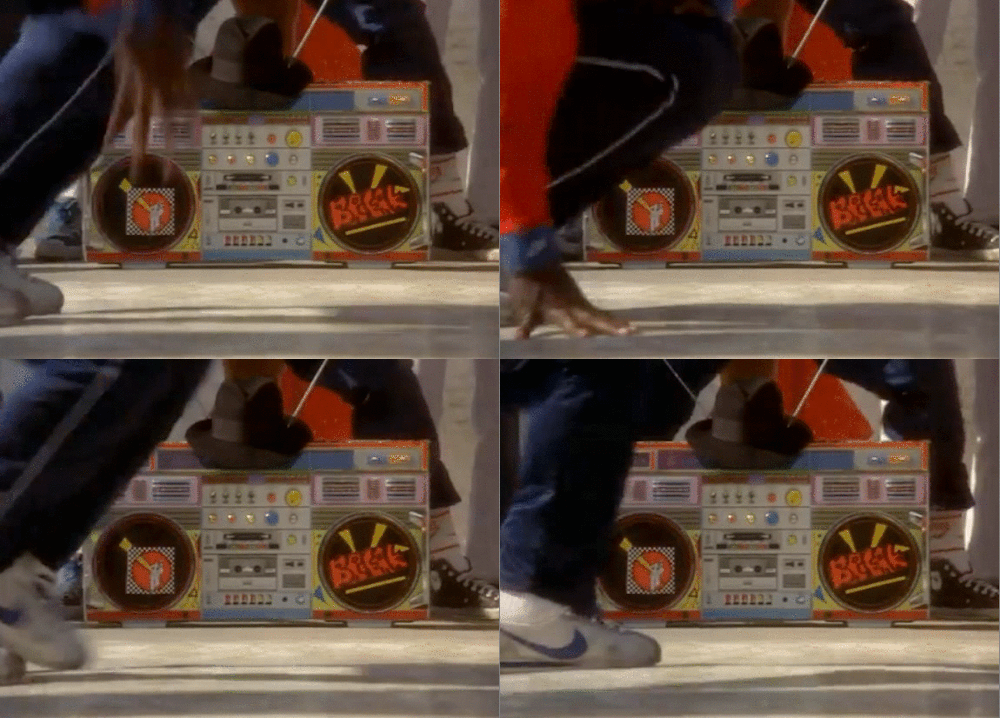
Breakin'

Breakin', released as Breakdance: The Movie in some countries, is a 1984 breakdancing-themed film directed by Joel Silberg. The film setting was inspired by a German documentary entitled Breakin' and Enterin' set in the Los Angeles multi-racial hip hop club Radiotron, based out of Macarthur Park in Los Angeles. Many of the artists and dancers, including Ice-T (who makes his movie debut as a club MC) and Boogaloo Shrimp, went straight from Breakin' and Enterin' to star in Breakin'. Ice-T has stated he considers the film and his own performance in it to be "wack".
http://en.wikipedia.org/wiki/Breakin%27

I just viewed an old tape of "Breakin'" last night. It's been 17 years since I first viewed it at the movies. However, I can't believe the powerful effect it still has on me. Yes, admittedly, the plot is not original, the screenplay is truly by-the-numbers, and the acting is generally amateurish. Yet, in spite of these shortcomings, the movie is still catchy, sincere, and engrossing. That's because of the talented stars who really love what they do, namely, breakdancing and "poppin' and lockin'," along with the stimulating, get-on-your-feet dance music.

This movie is like a time capsule of the 80s, with hints of the future. Moreover, I still find it to be inspirational, motivational, and hypnotic. Looking at these streetdancers and the jazz dancer go after their dreams with sheer determination, talent, and grit makes me want to jump up and do the same thing! Yes, I'm nearly fifty, but looking at this movie gave me another shot of adrenalin to do what I need to do in my daily life. "Ain't no stoppin' us" is the endless musical mantra in "Breakin'"...nothing stopped the dancers, and nothing's going to stop me, either. Watch "Breakin'" for yourself, and you'll see what I mean. 9/10 Rating.
zach-27
http://www.imdb.com/title/tt0086998/reviews?ref_=tt_urv

now lovingly restored on DVD and it's a treat; amazing original breakdancing scenes from Los Angeles, riotously colourful wardrobes, an incredibly high quality 80s electro/freestyle soundtrack, and all played out with such beautiful innocence and sincerity
William Bennett
http://williambennett.blogspot.co.uk/2012/04/fillmore-discos-69.html

There are going to be several street dancing movies this summer and “Breakin’” is the first one, sweet and high-spirited and with three dancers who are so good they deserve a better screenplay. This is really two movies: A stiff and awkward story, interrupted by dance sequences of astonishing grace and power.

The story, alas, is predictable from beginning to end. We meet Kelly, a young Los Angeles dancer (Lucinda Dickey) who is the student of a hateful choreographer. Through a friend she meets a couple of break-dancers on the boardwalk at Venice. They have a concept of dancing that’s totally different from hers; while she polishes technique, they turn up the volume on their ghetto blasters and lose themselves in the joy of street dancing. She likes them, dances with them, and they form a team.

The fact is, there’s a movie here somewhere. Dickey has a wonderfully fresh presence and a level-headed likeability, and she can dance (we will, I think, hear a lot more from her). Chambers and Quinones are two of the more original movie characters in a long time. I’ll bet an interesting documentary could have been made about how these three performers met, how they learned to work together, how the street dancers taught their moves to the traditionally trained Dickey, and how they got along offscreen. Those subjects supply the fictional plot of this movie – but the script is too amateurish and the direction too clumsy to take advantage of the great material.

You like street dancing? This is a great movie, if you can manage to ignore about two-thirds of it.
Roger Ebert
http://www.rogerebert.com/reviews/breakin-1984 

In the movie Breakin‘, when Turbo’s moon walk sweeps the sidewalk to Kraftwerk’s “Tour de France”, cinematic history was made. That scene will be noted in the annals of time as the greatest two minutes in cinema ever, forever, until the end of time.

Greatest two minutes of cinematic history, AKA Turbo broom scene:


Breakin‘ has everything a good movie should have; leather gloves, moon walking, nice butts in tights, electro music, a guy with no legs doing the windmill and Ice mutha fuckin T. Breakin’ literally broke the mold when they came up with that insanely awesome movie formula.

This is real break dancing -not this bullshit “so you think you can dance” kinda break dancing that we see so much of in today’s society. This is breakin’ back when it was more punk rock than punk rock, with ripped T-shirts, leather, studs, spray paint and took place in the streets. To sum it up I will quote the illustrious Bar-Kays it was a “Freak show, baby, baby on the dance floor… They’re wearin’ miniskirts and camisoles, tight leather pants or nothing at all… Guys with guys, chicks with chicks, it really doesn’t matter they just do it for the kicks”. Those are words to live by my friends.

Which brings me to my last point of proof that this is one of, if not thee best movie of all time. The sound track is insanely good. I had this 12′ growing up and it largely inspired my entire music making process. The music in the movie is proper Electro, back when that term was used to describe artist who made people dance to their unique brand of electronic funk, not this new bastardization of that term by EDM dicks with mouse masks; seriously, fuck those guys.

The soundtrack features amazing bands like the Bar-Kays, Kraftwerk, The Art of Noise and Hot Streak. The jewel of the sound-track and the movie is Ice-T and the Glove’s amazing 808 and 303 acid bass line, hip-hop monster “Reckless”.
SINS
http://mishkanyc.com/bloglin/2013/05/21/pop-it-to-lock-it-break-it-to-make-it-breakin-1984/ 

Monday, 3 February 2014

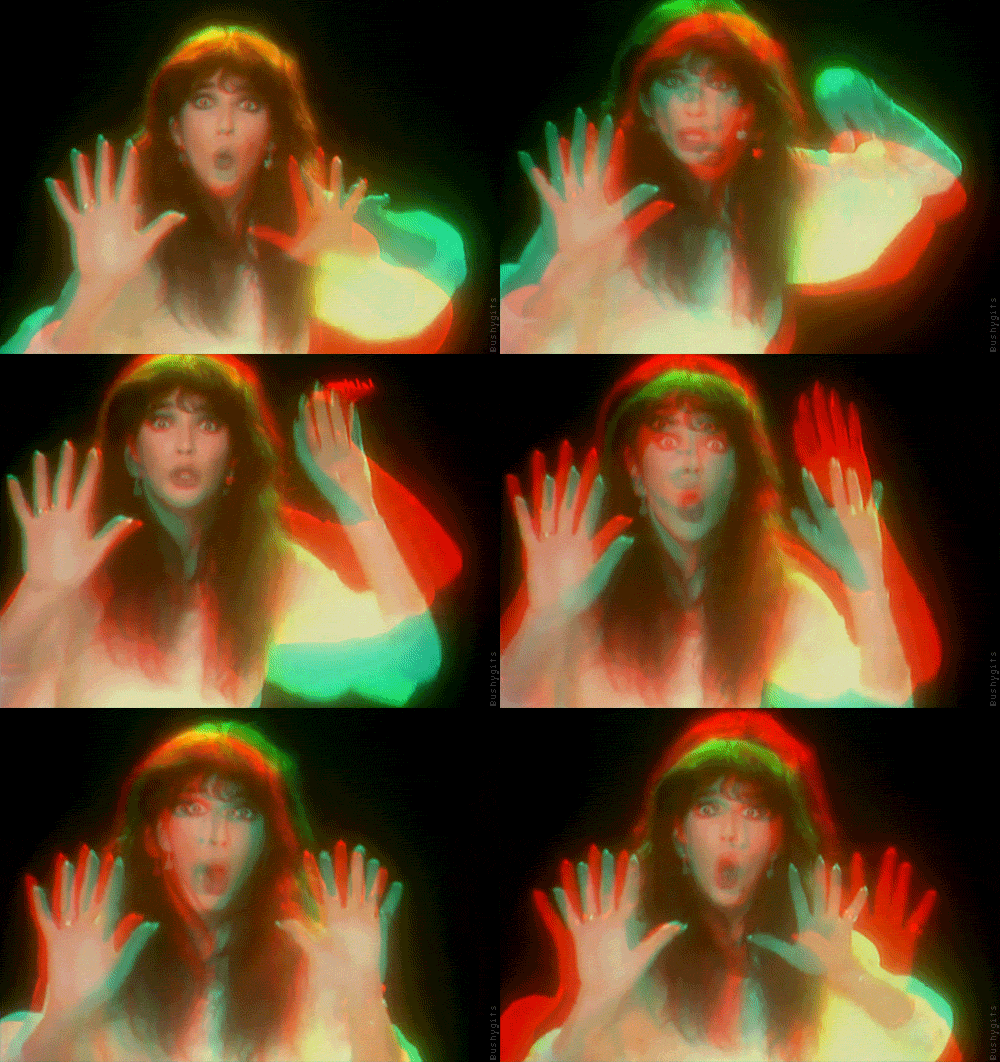
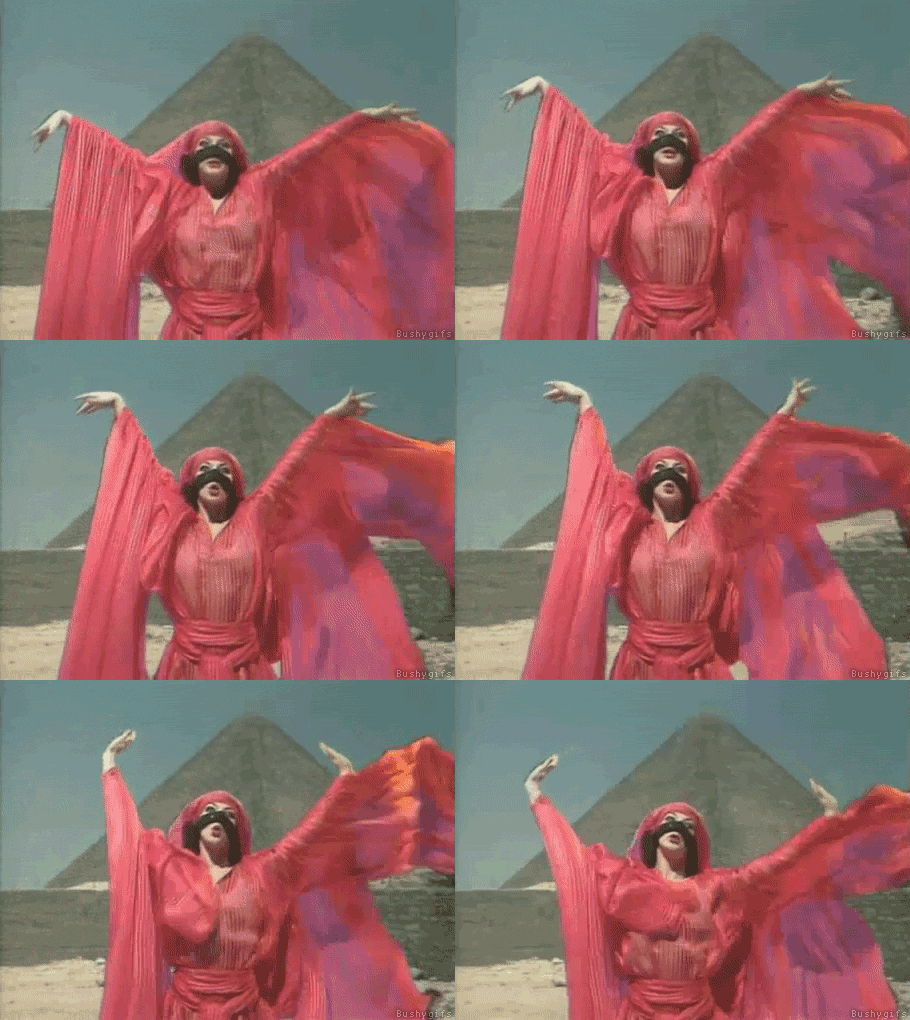
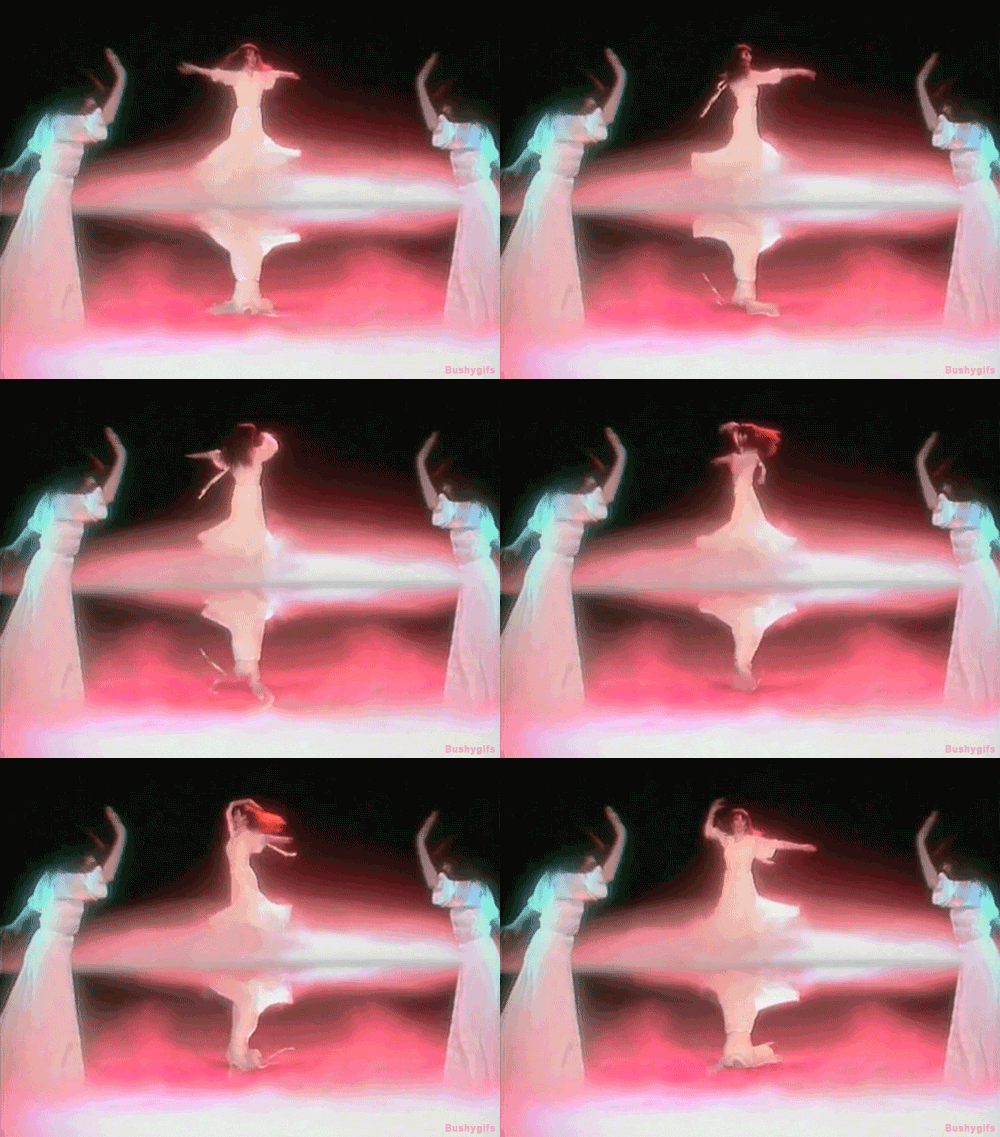
Kate Bush - TV

Catherine "Kate" Bush, CBE (born 30 July 1958) is an English singer-songwriter, musician and record producer. Her eclectic musical style and idiosyncratic vocal style have made her one of the United Kingdom's most successful solo female performers of the past 35 years.

During the same period as her 1979 Tour of Life, she made numerous television appearances around the world, including Top of the Pops in the United Kingdom, Bios Bahnhof in Germany, and Saturday Night Live in the United States (with Paul Shaffer on piano). On 28 December 1979, BBC TV aired the Kate Bush Christmas Special. It was recorded in October 1979 at the BBC Studios in Birmingham, England; choreography by Anthony Van Laast. As well as playing songs from her first two albums, she played "December Will Be Magic Again", and "Violin" from her forthcoming album, Never for Ever. Peter Gabriel made a guest appearance to play "Here Comes the Flood", and a duet of Roy Harper's "Another Day" with Bush.
http://en.wikipedia.org/wiki/Kate_Bush

In 1978 Kate made her debut on Dutch television in a program that has gotten to be known as “De Efteling Special”, which was broadcasted on 11 May 1978 at 19.20 hours on Channel 1 (Ned 1). The amusement park De Efteling served as a backdrop for six songs of The Kick Inside: Moving, Wuthering Heights, Them Heavy People, Strange Phenomena, The Man With The Child In His Eyes and The Kick Inside.

Early 1978 the Haunted Castle is completed and the opening is scheduled on 10 May that year. De Efteling never built such a costly attraction before (it costed 1.6 million Euros at the time) and wanted to promote it as much as possible. The designer appeared in a popular talk show and in April a documentary featuring the Haunted Castle was made by filmmaker Rien van Wijk, who was eager to shoot in the latest attraction before it officially opened. Kate, who just had a big hit in the Netherlands with Wuthering Heights, made her debut on Dutch television in this special. Her popularity was used to draw the attention to the Haunted Castle (and the popularity of De Efteling could draw the attention to Kate).
Birgitte
http://www.angelfire.com/stars4/katebush/EftelingSpecial.html


I found it difficult not to share this freshly uploaded winter treat - the whole of Kate Bush’s Christmas Television Special from 1979. Filmed in October of that year, the show stars the beautiful songstress, together with her band and Peter Gabriel. While we have shown one song from this before, we have never managed to find the whole program online until now - and it’s been worth the wait. Enjoy.
Paul Gallagher
http://dangerousminds.net/comments/kate_bush_tv_show_christmas_1979

I was recently asked about this BBC TV special and I thought I'd share my comments here.  Kate: Kate Bush Christmas Special is a stage performance by Kate Bush with her special guest Peter Gabriel.  Though most of the songs are not holiday ones, they come from Bush’s first three albums (Never for Ever her third album would be released in 1980 after this 1979 TV special was taped).  The performances include costumes, choreographed dances and a wind machine, creating an eclectic music TV special to say the least.

This is one of the programs that makes my research quite difficult--because it calls itself a Christmas Special yet it contains only one performance of a Christmas song "December Will Be Magic Again"  (a song that wouldn't be released as a single by Bush until the following year, in 1980).  TV programming that calls itself a Christmas Special and yet contains little to no Christmas entertainment is actually quite common--especially on the BBC.

Between the end of November and the end of December each year, there is quite a bit of special programming on television.  Remember Elvis' 1968 Comeback Special--it aired in December that year and includes only one holiday song, a performance of "Blue Christmas."  Is it considered a Christmas special?  No, not really.  And so, despite its title, the lack of holiday programming in Kate Bush's 1979 TV special means it shouldn't be considered a Christmas special either.  But the Kate Bush Christmas Special is certainly worth watching!  Check it out:
Joanna
http://www.christmastvhistory.com/2012/04/kate-bush-christmas-special-1979.html


  • Concept Video - Kate Bush used to love making weird mini-movies for her songs in the 80s. Notable examples include:
    • "Experiment IV", a horror movie pastiche in which a bunch of government scientists in a spooky military facility, including Dawn French and a pre-House Hugh Laurie, create an unstoppable sonic weapon. As you expected it might, the weapon, played by Kate Bush in a ghost outfit, rampages around and kills everyone horribly. Hoorah!
    • "Cloudbusting" - this one is based on the life of Wilhelm Reich. The reclusive scientist pursued by naughty government types is played by Donald Sutherland, Kate Bush plays his eight-year old son (in a hilariously unconvincing child costume) and the design of the very cool rain machine (Cloudbuster) was inspired by H.R. Giger.
    • "Hounds of Love" - a pastiche Hitchcock thriller.
    • The Line, The Cross, And The Curve, a 1993 short film based on her album The Red Shoes, starring herself, Miranda Richardson, and Lindsay Kemp.
    • "Running Up That Hill": Largely an elaborate dance piece done as a Take That at those critics who slammed the "Wuthering Heights" video.
    • "This Woman's Work": A renarration of the Movie "She's Having a Baby"
    • "Misty": an animation about a woman who sleeps with a snowman and wakes up to find that he's melted.
http://tvtropes.org/pmwiki/pmwiki.php/Music/KateBush


Kate Bush has sent out a message of support to an axed contestant on The Voice UK.

Liam Tamne lost out to John Pritchard in the Battle Round on Saturday's (May 25) show, after they sang a version of Phil Collins and Philip Bailey's 'Easy Lover'.

will.i.am had previously picked Tamne for his team after he sang Kate Bush's song 'This Woman's Work'.

On her website, Bush wrote that she was "sad" about Tamne's exit and wished him luck for the future.

"I was sad to see that Liam didn't get through on The Voice this week. It must be so tough for all the performers who don't stay in the show," she said.

"Liam, you mustn't be disheartened. You really have a special talent and you're a fantastic singer. You've already been heard and appreciated by a huge audience.
"Try not to be too disappointed. Just keep going. I'm sure that your nan would be very proud of you having achieved so much.

"Good luck with all your future projects. Very best wishes, Kate."

Jessie J and Danny O'Donoghue were visibly shocked when will.i.am elected to choose Pritchard over Tamne on Saturday's show.
Tom Eames
http://www.digitalspy.co.uk/tv/s154/the-voice-uk/news/a485290/kate-bush-sends-support-to-axed-the-voice-uk-singer-liam-tamne.html


I still find out that many fans don't know about this video. So I uploaded it myself.

Köln Frechen Benzelrather Eisenbahn KATE BUSH'S FIRST TV (Kite & Wuthering Heights LIVE) Germany February 9th 1978

Try to pronounce the name if you are not German! :)
Sharmilka


Saturday, 1 February 2014

homage


Lucio Fontana - Concetto spaziale, La fine di Dio, 1963

Extract from

Dawn was already breaking, and a light green mist was forming on the skin of the mourners' faces, on the plaster of the walls, and on the gray blanket of the sky, in which gaps had been torn here and there by the bitter wind of early morning; and through the rents a pinkness was visible, like the new flesh that forms over a wound. The crowd continued to wait in the courtyard, praying aloud, and every so often interrupting its prayers to give expression to its grief.

   At about ten in the morning pandemonium broke loose. Weary of the long wait, impatient to have news of their dear ones, to know if they were really dead or if there was any hope of saving them, and fearful of being betrayed by the doctors and orderlies, the crowd began yelling, cursing and hurling stones against the windowpanes; and finally, by sheer weight of numbers, they broke open the doors. As soon as the heavy portals yielded the deafening, ferocious clamor died down as if by magic; and silently, like a pack of wolves, panting, gritting their teeth, every so often peering through doorways, running with lowered heads through the passages of the ancient building, made fetid and filthy by time and neglect, the crowd invaded the hospital.

     But having reached the entrance to a cloister, from which dark corridors radiated in every direction, they burst into a terrible cry, and halted, petrified with horror. On the floors, piled up on heaps of garbage, bloodstained garments and damp straw, lay hundreds and hundreds of disfigured corpses, their heads enormous, swollen through suffocation and blue, green and purple in color, their faces crushed, their limbs truncated or torn right off by the violence of the explosions. In a corner of the cloister stood a pyramid of heads with wide-open eyes and gaping mouths. With loud cries, frantic wails and savage laments the crowd threw themselves on the dead, calling them by name in voices that were terrible to hear, fighting for possession of those headless trunks, those torn limbs, those severed heads, those miserable remains which deluded pity and love seemed to recognize.

   Surely no human eye ever witnessed a struggle so fierce, nor yet so pitiful. Every scrap of flesh and bone was fought for by ten or twenty of those demented creatures, who were maddened by grief and even more by the fear of seeing their own dead carried off by others, of seeing them stolen by their rivals. And that which the raid had failed to do was finally accomplished by their macabre fury, their mad pity; for every corpse, torn, truncated, rent asunder, ripped to pieces by a hundred eager hands, became the prey of ten or twenty demented creatures, who ran off, pursued by hoards of yelling people, hugging to their breasts the miserable remains which they had succeeded in rescuing from the fierce pity of their fellows. The wild affray spread from the cloisters and corridors of the Ospedale dei Pellegrini into the streets and alleys, and finally spent its fury in the cellars of the city's slums, where the people could at last find an outlet for their pity and love in tears and in the payment of their final homage to the mangled corpses of their dear ones.

Translated from the Italian by David Moore

https://www.goodreads.com/book/show/15799199-the-skin