Friday, 13 September 2013

Ryan Trecartin - A Family Finds Entertainment

Ryan Trecartin (born 1981, Webster, Texas) is an artist and filmmaker currently based in Los Angeles. He studied at the Rhode Island School of Design, graduating with a BFA in 2004. Trecartin has since lived and worked in New Orleans, Los Angeles, Philadelphia and Miami.
http://en.wikipedia.org/wiki/Ryan_Trecartin

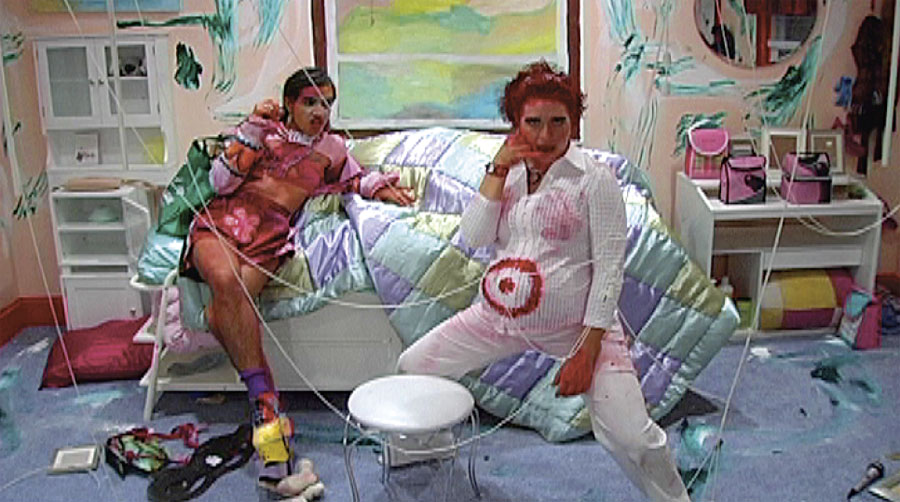
Trecartin’s first feature-length film, A Family Finds Entertainment (2004), was submitted as his final thesis at the Rhode Island School of Design. He was 23. It introduces a number of themes which recur throughout his work: identity as roleplay, the struggle between individual expression and communal belonging, family politics, queer culture, globalisation – and less abstract things like house parties, make-up, TV static, poster paint.

It’s a little absurd to boil this filmic fugue state down to a bare-bones narrative, but here we go: AFFE follows a young, potentially psychopathic man called Skippy (played by Trecartin) who locks himself in bathroom while his friends have a party, tells his parents he is gay, goes outside, becomes the subject of a documentary, gets run over by a car and is magically resurrected by a group sing-along before a round of fireworks. These plot coordinates create a loose framework for forty-two minutes of playful, schizoid imagery and wildly gestural performance, a film that masquerades as surrealist autobiography while dramatising a complex debate about the possibility of belonging. 
Patrick Langley
http://www.thewhitereview.org/art/ryan-trecartin-the-real-internet-is-inside-you/

One may ask if there is some merit to this, artistically, if considered to be an experiment in creating an insufferable, obnoxious piece. However, there does not seem to be a point to this beyond that. It felt like a waste of time. Sure, it's impossible to sit through without curling into a fetal position begging for the horrific imagery to go away, and no other work I have witnessed has achieved that. But I don't know anyone who would want to sit through that, let alone enjoy it. Some art can be difficult to enjoy, yes. But I don't see it in this case as a factor of how much the viewer thinks about it, but rather how little.

The characters include a flock of face-painted horrors, screaming nonsense at the camera, and various other colorful crazies. Trecartin uses a myriad of image-processing effects to achieve his goal (I think) of creating a convoluted, visually confusing mess of a piece. There is no cohesion, there is no plot, but that is not to its detriment. It would almost be laughably terrible if it attempted to tell a comprehensible story. But no, A Family Finds Entertainment seeks only to expose you to this world of horrors. It is a forty-minute view into a hellish place that may have once been inhabited by humans, but no longer.


If A Family Finds Entertainment can be reduced to a thumbnail description, this might be it: Trecartin stars as Skippy, a clownish but terrifyingly psychopathic boy who has locked himself in the upstairs bathroom of his family home during a wild party. Ignoring his siblings' and friends' pleas that he come out, he paces the little room, cutting himself with a knife and musing opaquely on his existential dilemma in a kind of King Lear-style delirium. Downstairs, the partiers are experiencing wild mood-swings and having complex, disassociated conversations (mostly about him) that are constantly interrupted by bursts of visual effects and animated sequences that disorient the cast of characters like so many lightening strikes. Eventually Skippy emerges, borrows money from his creepy, sexually inappropriate parents, and heads outdoors, where he runs into a documentary filmmaker who decides to make a movie about him; but then Skippy is immediately hit by a car and, apparently, killed. Back inside the house, a hyperactive girl named Shin, also played by Trecartin, gets a call on her cell phone with the bad news. She spends twenty or so hysteria-filled minutes trying to focus and construct a sentence linear enough to tell her friends what has happened. When she finally does, a band plays music that seems to magically raise the young man from the dead, and everyone runs outside and sets off fireworks. Then everyone runs back inside before the police show up.
Dennis Cooper
http://www.eai.org/title.htm?id=12079


Thursday, 12 September 2013

Yuck 'n Yum AGK TEASER 5

Last year's winners of the AGK Jeppe and Ed had a few words to say about their experience. Here is what they said...

Ed: The AGK was a really enjoyable experience. We came up with the idea for our entry on a Wednesday night and shot it the Thursday afternoon. We found that working quickly on a pressure-free project was a great way to get the creative juices flowing and try things that were out of our usual comfort zones. The night itself is a brilliant demonstration of the size and variety of Dundee's creative community, and a really good laugh to boot!

Jeppe: The prospect of singing in front of an audience was terrifying. But with the good spirit of the competition and the moral support of the Yuck 'n Yum people we manned up and delivered a performance worthy of “Best Video”. It was such great fun and I would recommend submitting, if not only for a fun night but also for a chance to win some nice money and to get exposure from Yuck 'n Yum.

AGK 2013 TEASER 5 from yucknyum on Vimeo.

Tuesday, 10 September 2013

benjackrobinson.com

Love’s Secret Domain, 2002, gouache on paper
Sparkly new site designed by web virtuoso Alex Tobin now online! Art, writing, film, karaoke and DJ sets, it's all here: http://benjackrobinson.com/

Monday, 9 September 2013

Surgeon ‎– Force & Form

Surgeon is the pseudonym of Anthony Child (born 1 May 1971), an English electronic musician and DJ.

Surgeon's musical style is characterised by his incorporation of the more cinematic and left field aspects of his musical background into his club-based material. His production, remix, and DJ repertoire are inspired by krautrock and industrial music bands such as Faust, Coil, and Whitehouse. In particular, the extent of Coil's influence is such that most of the track titles from Surgeon's Tresor album "Force and Form" are direct references to Coil recordings. Child also draws influence from Chicago house, Techno, Dub music, and Electro, and also from non-musical works by Mike Leigh, David Lynch, William S. Burroughs, Bret Easton Ellis, and Cindy Sherman.
http://en.wikipedia.org/wiki/Surgeon_%28musician%29

The ever-present 125-130 bpm thud at Berghain can be largely attributed to Tony ‘Surgeon’ Child’s early output, so influential are tracks such as ‘Atol’ and ‘Magneze’ that appeared in 1995 on Karl O’Connor’s Downwards imprint.

Child’s early material had an enormous kinetic energy about it, yet also sounded brittle, ready to snap. Force and Form moved away from this, inspired greatly by the avant-garde mysticism of Coil, a band that Child identifies as an essential part of his musical heritage. It’s a sprawling, experimental LP that owes a debt not just to Coil but also Throbbing Gristle and Liaisons Dangereuses, and to my mind it marks Surgeon as the premier exponent of techno over the last decade.
Toby Frith
http://www.factmag.com/2010/10/30/20-best-uk-techno/13/

This was a request, I had honestly forgotten about it; but after listening to it again after those few years, I have to say it has aged extremely well. Full of loopy, dark techno with industrial references both sonically and thematically (see Coil), it's a classic Surgeon album revealing in full his idiosyncratic tendencies for bastardizing righteous techno beats with weird atmospheres and post-breakbeat loops. On that account, he always reminded me of early PWOG, amongst others; but that may be just me. Anyway, it's no wonder he made a turn towards the tech/dubstep crossover during the last few years.

His downtempo interludes are (according to Anthony Child himself) influenced by the work of his mentor/friend, Napalm Death's ex-drummer Mick Harris aka Scorn or Lull, who also contributed a dub in a 12" of remakes of tracks from the album.
Europa
http://thelightofthenight.blogspot.co.uk/2010/05/force-form.html

There are four sides of vinyl on Force & Form, meaning that the four songs on the album each get an entire side to itself. Drop the needle at the outermost groove and the spinning record will emanate a ten-minute adventure into cycling tribal techno rhythms with heavy percussive bass. Unlike the Maurizio records, which also spin for epic lengths, the songs on Force & Form actually progress through actual movements, where rhythms change and new arrangements construct themselves as if two different techno records are being seamlessly mixed. Each of these four songs begin with several minutes of repetitive techno rhythms similar to the sort of tracks Child recorded for his Basictonalvocabulary album. After a few minutes of locked groove-type sounds, the songs then shift with the low-frequency bass rumbles being eclipsed by tranquil atmospheric tones. Soon the serene subtly of these high-frequencies gets shattered by the slowly growing construction of the next monolithic percussive hailstorm that will carry listeners through the final few minutes of the song. As if the rhythms weren't marvelous enough -- challenging even Mills himself as the latest contender for king of techno dancefloors -- Child's ability to craft brave multi-sectioned epics makes this an even more incredible album than anything he had accomplished up until this point.

http://www.allmusic.com/album/force-form-mw0000667630

Delicious, intelligent and groovy. This is an album where relentless drum loops give architecture to mysterious sound effects. After the brief intro, "Ice" delivers echoes of picks hitting crystals through a cavernous, throbbing cave. "Black Jackal Throwbacks" goes through three phases of wicked pulsating basslines and beats, with a thematic sound effect recurring. "Returning To The Purity Of Content" is 4/4 techno with shuffling samples that sound like it is clawing backwards (IDM moment). 6:50 in, the ever-experimental Anthony Child emerges with disjointed efx, voice samples from old places, telephone conversations, feedback, and tapes stutteringly fast-forwarded. The point to the dissonance is that as it dissolves into "At The Heart Of It All", the most melodic and modern-sounding of the 4 pieces on this CD, the contrast emerges. Whilst the last 3 pieces appear to explore a space before time, the final piece concludes the arc with modern-day electronica (refer to the introductory coo of synths). Beats build up the track until the synths fade off, leaving stylish beats syncopated with a busy clatter of whats-it's, to be bolstered by an electrifying low-fi doop. I hate the label IDM, but if it were to exist, this would be it in the shining form of Techno.  
FLuViRuS
http://www.discogs.com/Surgeon-ForceForm/release/779 

Thursday, 5 September 2013

Edgar Degas - Little Dancer Aged Fourteen

Little Dancer of Fourteen Years (French: La Petite Danseuse de Quatorze Ans) is a c. 1881 sculpture by Edgar Degas of a young student of the Paris Opera Ballet dance school named Marie van Goethem.

The sculpture is two-thirds life size and was originally sculpted in wax, an unusual choice of medium for the time. It is dressed in a real bodice, tutu and ballet slippers and has a wig of real hair. All but a hair ribbon and the tutu are covered in wax. The 28 bronze repetitions that appear in museums and galleries around the world today were cast after Degas's death. The tutus worn by the bronzes vary from museum to museum.
http://en.wikipedia.org/wiki/Little_Dancer_of_Fourteen_Years

The first exhibition of the clad figure caused an outcry, not because the subject was a child, but because she was so unattractive. Jules Claretie reported in Le Temps that he found the wax figure "peculiarly disturbing". "The lecherous little snout on this barely pubescent young girl, this little flower of the gutter, is unforgettable," he wrote. Paul Mantz's response was similar: "With bestial effrontery she moves her face forward, or rather her little muzzle - and this word is completely correct because the little girl is the beginning of a rat." (The adolescent corps de ballet at the Paris Opera were known as petits rats.) He goes on:

"Why is she so ugly? Why is her forehead, half covered by her hair, marked already, like her lips, with a profoundly vicious character?"

Today's public is not likely to make a lecherous interest in the body of a child the fault of the child herself, if only because so few of us are the kind of bowler-hatted, cigar-smoking, clubbable gentlemen who prowled the backstage corridors of the Paris Opera in the 1880s. If the nude figure is disturbing, it is because the child is underdeveloped for her stated age, because her breasts are mere buds on her narrow ribcage, because her pelvis is shallow and unformed and her belly slack and protuberant, because her thighs are wasted and her knees almost rachitic. This is what passed by gas footlights for a sylph - an undernourished child for whom dancing was a one-way ticket to prostitution.

Degas is certainly responsible for stripping the figure of the adolescent dancer of cuteness, and we could argue that his intent is partly moral, but anyone who looks for compassion in the work will not find it. The visual language of compassion was unusable for any serious artist in the 1870s and 80s, because the public art of the period oozed sentiment. Pretty beggars and plump rosy little girlies with tears in their eyes were as often to be encountered then, as fluffy kittens are today. Degas dispensed with pathos as summarily as he dispensed with glazes. His surfaces get thinner and poorer, the pigment goes on drier and drier. Line becomes more and more important, burning through the bursts of aniline colour that begin to dominate in the later work, like the skull beneath the stage-lit skin.


The debut of the "Little Dancer" produced great controversy. "Almost thirty responses to the 'Little Dancer' from Degas' lifetime can now be assembled," show curator Richard Kendall writes in the catalog.

Among positive reactions from critics covering art in Paris, Paul de Charry singled out its "extraordinary reality" and called it "a real masterpiece." Joris-Karl Huysmans called it "the first truly modern attempt at sculpture I know," while to Nina de Villard it was "the leading expression of a new art."

Others compared it to art from earlier ages: Gothic sculpture, medieval Spanish sculpture, Egyptian sculpture. Collector Louisine Havemeyer, calling it both classic and modern, referred to it as "One of the greatest works of art since the dynasties of the Nile." Comparisons with older art may have been made partly because it was exhibited in a glass case, like classical sculpture in the Louvre, and was dressed in wig and clothes. Egyptian sculptures were often shown wearing wigs, Gothic and Spanish sculptures were draped with real fabric.

On the negative side, reviewer Louis Enault called the sculpture "quite simply hideous," and added, "Never has the misfortune of adolescence been more sadly represented." An anonymous critic, writing in an English journal, said the sculpture depicted a "semi-idiot" and added, "Can art descend lower?"

Because of the wax medium and the clothes, some compared the dancer to Madame Tussaud's waxworks, to puppets, dolls, dressmakers' mannequins. One critic, Elie de Mont, compared the dancer to a monkey. Another, Paul Mantz, referred to her as a "flower of precocious depravity," with a "face marked by the hateful promise of every vice" and "bearing the signs of a profoundly heinous character."

Such violent reactions originated in issues of the time. The dancers of the Paris opera often came from the lower classes (Marie van Goethem was the daughter of a tailor and a laundress), were sought after as sexual partners by rich dandies, and frequently became prostitutes. So the "Little Dancer" could be seen as someone destined for a life of depravity.

Some thought her Degas' indictment of a society that winked at the practices that went on at the opera and thereby weakened the nation's moral fiber.


Today Degas is called both a misogynist and a pioneering feminist. Did the artist present an authentic and intimate view of women's lives, sympathetic to the cruelties they suffered? Or, did he regard women as depraved and lesser beings who were also desired and fodder for the fantasies of men?

Some say the popular appeal of Impressionist artists has blinded us from valid criticisms of Degas. He was not motivated by a desire to understand, they say. Rather, he was dominated by a "ruthless curiosity of a bourgeois gone slumming," writes Bram Dijkstra in "Idols of Perversity," a book about the iconography of female stereotypes in the 19th century. A work like "Repose," a monotype in black ink on china paper, buttresses the point, Dijkstra writes. In it, three faceless prostitutes lie in carnal repose, scratching and stretching between customers. (Picasso owned these montotypes, which partly inspired the sexual immediacy in his brothel scene, "Les Demoiselles d'Avignon.")

Some, though, believe Degas was capable of dignifying women. He plucked them from the realm of bourgeois fantasy and rooted them in their true social realities, art historians in this other camp attest. Women in many of Degas' rehearsal halls scenes, for example, bear expressions of self-possessed absorption, they argue.

"The paradox, of course, is that Degas created some of the most appealing, believable and intelligent-looking women in all of art," wrote Deborah Solomon in a 1998 New York Times article. The truth probably lies somewhere between the extreme arguments. Consciously and unconsciously, the artist probably both upheld prevailing prejudices while also subverting them.

To this day, the little dancer's body elicits strong reactions. The sculpture is recognized as modern today, allowing a subtler appreciation for its beauty. But many still describe her face and limbs as less than pretty, to say the least. It's that ambiguity and tension that make much of Degas work so intriguing to contemporary audiences. During his own life, at a time when feminism was gaining a foothold in the world, Degas continued to rework "Little Dancer," which remained in his studio to the end of his life. He refused to part with it when potential buyers came along over the years, and some historians report he, only half jokingly, called her his "daughter."
Mary Louise Schumacher
http://www.internationalarts.org/degas_exhibition/doc/Degas%20Milw%20Journal%20Sentinel%20Schumacher%20021205.pdf

Tuesday, 3 September 2013

stutters.


Rineke Dijkstra - Almeriaa Wormer, The Netherlands, Jun 23, 1996, 1996

Extract from Peter Sotos - Mine:

I have to pin the words down, cut them out and place them as far as possible from the dunce economy. I’m not an exegete. But I take the words and ideas and stutters and stick them somewhere far more successful. You’ll understand this, finally, when I demean myself enough to tell you what I do with the words that these mouthy pigs just repeat often enough to tell you that they stand behind them. It’s not what I take, or who I take them away from. But where I put them. Not rewrite them. Not change or charge the context. I identify them. I don’t, idiot, masturbate with them. I can’t imagine wanting to do anything without having these words fully included. I wouldn’t even consider doing anything without them. The cunts that make cartoons out of their ideas. Little collages and signatures and slack versions. Strippers and songwriters and female’d max factors. I live all over them. I write through them, use them, come away with little more than a dangling possible.

…

What I do is inescapable.

http://www.ninebandedbooks.com/mine/

Sunday, 1 September 2013

Cindy Sherman - Sex Pictures

Untitled #305, 1994

Cynthia "Cindy" Morris Sherman (born January 19, 1954) is an American photographer and film director, best known for her conceptual portraits. Through a number of different series of works, Sherman has sought to raise challenging and important questions about the role and representation of women in society, the media and the nature of the creation of art.

Provoked by the 1989 NEA funding controversy involving photographs by Robert Mapplethorpe and Andres Serrano at the Corcoran Gallery of Art, as well as the way Jeff Koons modelled his porn star wife in his "Made in Heaven" series, Sherman produced the Sex series in 1989. For once she removed herself from the shots, as these photographs featured pieced-together medical dummies in flagrante delicto.
http://en.wikipedia.org/wiki/Cindy_Sherman


Untitled #259, 1992

They are just dolls—or, rather, bits culled from several different medical anatomical mannequins—but exceedingly discomfiting dismembered dolls posed in graphically and weirdly contorted sexual positions. They are dolls that can embarrass us. The Sex Pictures series combines the gruesome qualities of fairy tales with the victim-oriented centerfold images and adds a grotesque and blatantly sexual quality. The combination is disturbing to say the least. They’re even a tad disturbing to Sherman herself: “I have this juvenile fascination with things that are repulsive. It intrigues me why certain things are repulsive. To think about why something repulses me makes me that much more interested in it.”

It’s not surprising that many people find the Sex Pictures images offensive. In a way, Sherman deliberately made them offensive. The series were created, in part, as a response to the controversy surrounding the attempts of conservative legislators to punish the National Endowment of the Arts for providing some support to photographers like Robert Mapplethorpe and Andres Serrano. In classic Cindy Sherman style, though, the photographs act on several levels simultaneously. They are a comment on the intersection of art and taste, they are a comment on pornography and the way porn objectifies the men and women who pose for it, they are a comment on social discomfort with overt sexuality, and they are a comment on the relationship between sex and violence. Yet the emphasis is still on creating a striking image that seems simultaneously familiar and strange.
Greg Fallis
http://www.utata.org/sundaysalon/cindy-sherman/ 

Untitled #250, 1992

My ideas are not developed before I actually do the pieces. It's good that you see it in that way. I never thought of the whole childhood thing and playing with dolls and dressing them up in regard to the newest work. For me it was out of boredom from using myself in the work, and feeling tied to that way of working. I became more interested and fascinated by the basics of what these prosthetic body parts were and I was just trying to use them without having to wear them myself. The whole series evolved from two mannequins — one female (the one positioned animal-like on all fours with the doll) and the other one male (the guy with the axe in the S-M scenario). These are the two most basic mannequins. It could almost be my other work except for the fact that they are mannequins and they are showing their sexual parts. I've done nothing abstract with the figure, and it's just a basic pose. I started out with these basic poses and it started to develop into different directions. I started taking apart the mannequins — just throwing body parts here and there. You know, if I wanted breasts I would just drape some breasts on the mannequin.
http://www.jca-online.com/sherman.html

Untitled #264, 1992

By now, Sherman is completely absent from her work, replacing herself with mannequins and prosthetic body parts. While Eagleton discusses postmodernism’s preoccupation with body parts, such as “[m]angled members, [and] tormented torsos”, Brehm discloses that effigies are a recurrent motif in postmodern visual work, explaining that “this new ‘physical art’ sets out to question traditional images of the body and the human being”. Sherman’s mannequins are imitations of human beings, standing in to represent human life. Thus, the “idea of the individual is countered by a standardized replica of the body”, the mannequin, who is synonymous to all others and, as a depiction of humankind, denies the possibility of individuality and spiritual depth. Furthermore, mannequins are “already stamped with the sign of DEATH”, acting as a stony reminder of human corporeality, and enabling artists to explore their metaphoric doubt in “autonomous subjects… Rather, this construct is merely a philosophical and cultural mystification”.
Alison Gibbons 
http://www.route57.group.shef.ac.uk/2nfalisongibbons2.html