Saturday, 5 April 2014

Sarah Lucas - NUDS


NUD 18, 2009

Sarah Lucas (born 1962) is an English artist. She is part of the generation of Young British Artists who emerged during the 1990s. Her works frequently employ visual puns and bawdy humour, and include photography, collage and found objects.  
http://en.wikipedia.org/wiki/Sarah_Lucas

NUD CYCLADIC 15, 2010

In 2009 Sarah Lucas starts NUDS, a series of new works, sculptures where stuffed tights on plinths of concrete breeze blocks assume polymorphic shapes. Recently, casted in bronze, NUDS have gone beyond representation to become pure, polished, shining forms. Suggestions of, allusions to limbs of female and male bodies embrace entwined, entangled, breasts and genitalia melt one into the other in the eternal fight between Eros and Thanatos. The third gallery at Whitechapel, which opens with Self-Portrait, 2000, outlined in cigarettes on brown paper, shows in all their sculpted, elegant morphism, the cast bronzes NUDS 2013 like Nduda, Realidad, Hoolian, Nahuiollin.
Floriana Piqué

NUD 19, 2009

With her series of "NUDS" sculptures, begun in 2009, Lucas heightened her work's abstraction. Each features stockings stuffed with foam on a cinder-block plinth. The forms are twisted, like balloon sculptures, to evoke tangles of swollen limbs, the gatherings in the fabric their orifices. The stockings hark back to an early sculpture included here, Bunny Gets Snookered #1 (1997), which straightforwardly represents a nude made out of stockings draped over a chair. The "NUDS" sculptures, however, deliteralize this impulse, introducing a Brancusi-esque indirectness. They make one feel unwantedly, unspecifically illicit. A series of recent versions substitute the stuffed stockings with bronze casts of them, highlighting the Brancusi allusion while sacrificing the fertile associations arising from the mottled fleshy surfaces of the stockings. The polished bronze connotes "figure sculpture" before we have assimilated the abstraction of the form.  
Mark Prince

Obsidiana, 2012

Rail: Talk a bit about the Nuds Cycladic show that you did at the Museum of Cycladic Art. I know it kind of grew out of your bunny sculptures and developed into this sort of human form.

Lucas: I suppose it’s obvious to say they developed out of the bunnies because they use the same materials. But in a strange way they developed out of Penetralia. That was the next thing to come along. There is something very organic and branchy and sprite-like about them. You start making something, and it suddenly jumps to life and it seems so clear that you can’t believe you didn’t see that years ago. I mean, there is no reason why I shouldn’t have done something like that immediately after doing the bunnies. I do tend to jump around from one thing to another just for my own amusement. I like the change of materials. Enough fluff up your nose for so long and then you start to think, “Actually, I wouldn’t mind dealing with something else for a bit.” So that’s one thing. But I think it also just depends how you have your point of view adjusted at any particular moment. I really think that having it adjusted into these trees, and the “branchiness,” and the organic things, lead me to notice that about the Nuds. The first Nud was actually just a screwed up old bunny that had been in the back of a cupboard for some years. When I went through the cupboard and came across it, I suddenly saw something in it that I hadn’t seen when I screwed it up.

Rail: How did the bunnies come about to begin with?

Lucas: The first bunny, actually a hare, was started around the time I had this shop. I decided to make a kind of the Tortoise and the Hare sculpture, which actually never worked out, so I abandoned it. I stuffed the tights to try and make a kind of hare’s legs—it does look a bit like a hare’s legs—and at the time it was stuffed with newspaper. There was something about those legs. I never worked out the tortoise bit and I just thought it was a bloody silly idea anyway, but there was something intriguing about the life-likeness of those legs, so I put them on a top shelf in my kitchen at the time. When I returned to it some years later I wasn’t thinking of the tortoise and the hare; I don’t know what I was actually thinking of, but I remembered the sexiness of these legs. Only this time I decided to stuff them with fluffy cotton. It was when I stood back and looked at them around a chair that I thought, “There’s something so going on here.” So it developed out of that, really.

Wednesday, 2 April 2014

Receipts

Bought a few items:


Jeff Jackson - Mira Corpora  (Two Dollar Radio), £4.45
https://www.goodreads.com/book/show/17347666-mira-corpora

Serge Gainsbourg - Comme Un Boomerang (Wrasse) 2CD, £6.75
http://www.allmusic.com/album/best-of-gainsbourg-comme-un-boomerang-mw0002118135

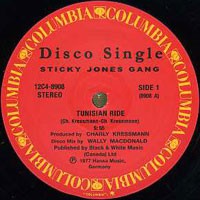
Sticky Jones Gang / Sailor ‎– Tunisian Ride / Down By The Docks (Columbia) 12", £5.99
http://www.discogs.com/Sticky-Jones-Gang-Sailor-Tunisian-Ride-Down-By-The-Docks/release/4288046

Sunday, 30 March 2014

Ren & Stimpy - Powdered Toast Man


The Ren & Stimpy Show, often simply referred to as Ren & Stimpy, is an American animated television series, created by Canadian animator John Kricfalusi. The show premiered on August 11, 1991, on Nickelodeon as part of its Nicktoons block along with 'the titular characters: Ren Höek, an emotionally unstable chihuahua, and Stimpson J. Cat, a good-natured, dimwitted cat. The show ran for five seasons on the network. The show has received critical acclaim and developed a cult following during and after its run, while some critics credit it along with The Simpsons for leading the way for satirical animated shows like Beavis and Butt-head and South Park, and playing a significant role in television animation. Throughout its run, The Ren & Stimpy Show was controversial for its off-color humor, sexual innuendo, and violence which were rare for television animation of the time. This controversy contributed to the production staff's altercations with Nickelodeon's Standards and Practices department.
http://en.wikipedia.org/wiki/The_Ren_%26_Stimpy_Show

Powdered Toastman is a superhero seen in "Powdered Toast Man". He is an extremely dramatic and oblivious vigilante and spokesperson for Powdered Toast, the breakfast treat that "tastes just like sawdust". He was based on a Frank Zappa inspired character. Powdered Toast Man appeared in various Powdered Toast commercials within The Ren and Stimpy Show, and starred in two episodes of the show, "Powdered Toast Man vs. Waffle Woman" and "Powdered Toast Man" (which had a guest appearance by Frank Zappa as the Pope). Oddly, Powdered Toast doesn't taste right unless Powdered Toast Man farts on it before it is consumed.

Powdered Toast Man can fly, either by releasing flatulence, by inserting his head into a special toaster and launching from it, or merely by pushing off from the ground. Importantly, he flies backwards. He can also hover in mid-air. His powers include some offensive weapons: high-velocity raisins shot from his mouth, hyper-corrosive croutons fired from his armpit, butter pats that are launched from the top of his head, and hyper-acidic marmalade from his navel. There are several signals that alert Powdered Toast Man to danger — his tongue phone, the inflation of his briefs, the dissipation of the toast particles in his head, or the reading of emergency messages encoded in slices of olive loaf. He is apparently made entirely of Powdered Toast, as he can produce fully formed Powdered Toast by flicking his wrist or by separating his head (which is made of two pieces of toast) and scraping the interior with a butter knife. His head is therefore depicted as being made of two identical pieces of toast, each complete with a face.
http://renandstimpy.wikia.com/wiki/Powdered_Toastman

I remember when I first saw Powered Toastman. I begged my mom to find the Powdered Toast in the grocery stores and she gave me a weird look.

All of the drawings are incredible!!!!
Sandra Rivas
http://johnkstuff.blogspot.co.uk/2011/04/ren-and-stimpy-curiosities.html 

Early in the second season of Ren & Stimpy, there appeared a rollicking and utterly disrespectful segment called “Powdered Toast Man.” 1992. The character of Powdered Toast Man unified the clueless and self-important silliness of The Tick with the tendency to wreak havoc of, say, Inspector Clouseau or Maxwell Smart. Voiced by the incomparable Gary Owens—and you might not know the name, but if you’ve ever seen Laugh-In or Space Ghost, you sure as hell know his voice—Powdered Toast Man was the spokesman for, obviously, a product called Powdered Toast, which was billed as tasting “just like sawdust!” According to Wikipedia, he was based on the character of Studebacher Hoch, from the epic song “Billy The Mountain” of off the Mothers of Invention’s 1972 album Just Another Band from L.A. I frankly don’t quite see the connection, but anything’s possible.

It’s kind of amazing just how dark and subversive the Powdered Toast bit is. The anti-advertising message is just the start of it. Tasked with saving a kitten from being run over by a truck, Powdered Toast Man causes a passing jetliner to crash into the truck, thus saving the kitten at the expense of who knows how many lives (the injured survivors cheer him on anyway). A few moments later, Powdered Toast Man thoughtlessly tosses the kitten out of frame, where he is apparently run over by a truck, to judge from the sound effects. Later on, he uses the Bill of Rights for kindling. He induces projectiles to emerge from his armpits by doing that “fart noise” maneuver, he uses his own tongue as a telephone…....... actually, you really need to see the video to believe it. The satire of the prevailing superhero ethos really couldn’t be more savage—or more entertaining.
Martin Schneider
http://dangerousminds.net/comments/starring_frank_zappa_as_the_pope_ren_stimpys_powdered_toast_man_1992 


Powdered Toast Man had appeared in a bumper during season 1, and this time he takes center stage.  It’s significant because it’s the first time that Ren and Stimpy merely appear in cameo roles.  There would only be a few other instances in the series where the duo were minimal or absent entirely, but thankfully this episode is still enjoyable despite their limited screen time; it proves the show can be engaging following other characters.

The titular hero (this time played by veteran actor Gary Owens), normally disguised as a mild-mannered government clerk, kicks into action when he gets the all-important distress call.  First up in need of help is a cat crossing the street that’s about to be hit by a truck.  A common problem, but how PTM handles it is absurd:  He takes down an airplane to hit the truck before it collides with the adorable kitten.  Yay, hundreds of innocent lives lost, but at least the kitty is okay!  And he discards the feline very soon after getting another distress call anyway.

Next, the pope’s in trouble.  He’s been taken hostage by Muddy Mudskipper, who is now a villain, I guess.  Side note:  The Pope’s voiced by famed musician Frank Zappa, the only cartoon he ever did.  And one of his few roles, period.  It makes sense that he would voice a religious figure on a subversive cartoon; it totally fit in with his “challenge the system” personality.

After saving The Pope, it’s time for a more down-to-earth (but no less severe!) problem to solve:  Ren and Stimpy are out of their beloved Powdered Toast breakfast!  PTM zooms in, restocks them by scraping one of his toast heads, and takes off.  But the two are less than satisfied; it turns out PTM forgot to give the powdered toast that extra “spice” to make it extra nice.  So PTM returns, apologizes, and farts on their breakfast as he takes off again.  NOW, they’re pleased.  Hey, don’t ask me; maybe PTM’s farts are bakery fresh.

Finally, PTM rescues the president of the U.S. from his own zipper.  I’m surprised what the show got away with; what other kid’s cartoon was this edgy in 1992?  After a successful rescue (if you want to call it that; he’s clearly out of commission), PTM is abruptly made president, promising to deprive all citizens of their human rights.  I dunno, this may have been a funny gag at one time, but when you consider some corrupt/totalitarian governments in the world do just that, not to mention that we have to constantly remain vigilant to ensure that our own government doesn’t fall into the same trap, it loses much of its absurdity.  That said, the crowd at his inauguration doesn’t mind, so that makes the gag a little funny, I guess.

The cartoon ends with PTM and his beautiful secretary in need of some heat, so PTM casually burns the Bill of Rights and the Constitution in the fireplace.  Again, see the paragraph above; it’s honestly a little uncomfortable nowadays.  Doesn’t mean Nick was right to censor it back in the day, though; besides the obvious negative of censorship, it’s not like kids out there can imitate this action or anything.

“Powdered Toast Man” is a good episode, showcasing a superhero who gets results, but often in the worst way possible and not caring after he reaches his goal (besides the cat throwing, he places The Pope on a tall, remote mountain just because Ren and Stimpy need more breakfast).  And Gary Owens is perfect for the part, sounding sort of like a nasal Space Ghost.  “PTM”‘s flaw is that it’s merely a series of unconnected set pieces; as entertaining as they are, it’s just PTM going from one disaster to the next, with no particular story arc or momentum.  While season 4′s “Powdered Toast Man vs. Waffle Woman” had a simpler art style, it had a better plot and even a touch of emotion.  But we’ll cross that bridge when we come to it.
ianlueck
http://renandstimpyreviews.blog.com/2013/01/25/powdered-toast-man/ 


Friday, 28 March 2014

Navid Nuur - RENDERENDER @ DCA 28.03.14 - pictures

To the DCA this evening for the opening of Navid Nuur's show RENDERENDER, an "inventive and playful array of new and existing work" featuring "magical mixed media installations". I took a few photos and here they are:

When you end I begin, 2008-2014

The Dundee art massive

City Soil, 2009-2014


 Ours, 2013


Never Mind the Map Never Map the Mind, 2009-2013

Recaptured from the Collective, 2006-2014

Untitled (broken ellipse), 2014, Untitled, 2006-2014


 Untitled, 2014

Somewhere at night, black got stabbed, 2012

Untitled, 2014

http://www.dca.org.uk/whats-on/exhibitions/navid-nuur.html

Thursday, 27 March 2014

ART101 preview

ART101 is an actual thing, a YouTube channel that's due to launch sometime in 2014. What follows  is my interview with Art in Scotland from January with a compendium of clips and images: 


Dundee based artist Ben Robinson introduces his project ‘ART101‘, a YouTube channel created by Ben as a response to the government’s discussions to get rid of art education. Ben pitched his idea of an arts channel to the Dundee Visual Artist Award, and won thus helping him kickstart the project.

Art 101:
Written and directed by Ben Robinson
Performed by Morgan Cahn
Editing and FX by Andrew Maclean


Sequence 01 1 from Ben Robinson on Vimeo.

Sequence 02 from Ben Robinson on Vimeo.

Sequence 03 from Ben Robinson on Vimeo.

Sequence 04 2 from Ben Robinson on Vimeo.

Wednesday, 26 March 2014

Öyvind Fahlström - maps

ESSO-LSD, 1967

Öyvind Axel Christian Fahlström (1928–1976) was a Swedish Multimedia artist.

Although some critics such as Frances Richard dismissed him as a "throwback to Surrealism or Agitprop at worst" other critics, such as Mary Flanagan have seen his use of games as constituting examples of critical play.
http://en.wikipedia.org/wiki/%C3%96yvind_Fahlstr%C3%B6m

Pentagon Puzzle (detail), 1970

With images based on jigsaw puzzles, dollar bills, and pie charts throughout, it`s easy to see why Fahlstrom`s work gets lumped under the rubric of Pop. But he doesn`t really belong there. Notes 6 (Nixon`s Dreams), 1974, for instance, shows a blue-faced, insomniac Tricky Dick counting panthers jumping over a police barrier and an electrified map of South Vietnam lying on a catafalque surrounded by gold bullion. Notes 7 ("Gook"-masks), 1971-75, a handcolored etching, depicts Smokey Bear, Angela Davis, Uncle Sam, of course, and personifications of Hiroshima and South Africa. What American Pop-ist would base an entire composition on snatches of poetry by Sylvia Plath (Sixteen Elements from "Chile I," 1976/89), or include in a dense, rollicking silkscreen a request addressed "Dear Picasso" that the artist remove Guernica from MOMA until the United States withdraw from Southeast Asia (Column no. 2 [Picasso 90], 1973)?

Fahlstrom`s relative lack of critical lionization is belied by the fame of some of Pop`s abject, punk-rock offspring whose work was prefigured in his-among them Raymond Pettibon, Matthew Ritchie, Carroll Dunham, and Mike Kelley. In fact, any contemporary artist who mixes words with pictures, sociocultural reference with dreamlike personal form, or writing and performance with painterly and graphic production is, to a certain degree, Fahlstrom`s inheritor. There`s little about this artist that isn`t, still, en avant.

Indeed, like the late Mark Lombardi, whose post-Conceptual depictions of political and financial malfeasance bear a distinct relation to this very body of work, Fahlstrom is an artist one wishes were here to comment now: Guernica, rejected by the UN in February 2003 as a too-embarrassing backdrop for a press conference on Iraq, has again become symbolic in the struggle against a crypto-imperialist US-led war, while the problem of creating effective agitprop that maintains aesthetic independence is, of course, perennial.
Frances Richard 

http://www.mutualart.com/OpenArticle/Oyvind-Fahlstrom/12CD1BFCFB5F2215

Eddie (Silvie's Brother) in the Desert, 1966

His art was a stew of references, half-submerged allusions, enthusiasms and conversations, both with the living and the dead. It is difficult to see how, precisely, he got from A to B, from a fascination with Antonin Artaud (whom he translated) and Marquis de Sade to AA Milne's Winnie the Pooh, or from championing an American comic book artist like Robert Crumb, to producing an installation of shiny, flat metal cut-outs derived from the forms in Crumb's cartoons. And from here to his interactive artworks based on the Monopoly game, to his gorgeous annotated maps and to his final works, with their moveable elements (if nothing else, Fahlstrom's work is a precursor to the fridge magnet), and their pointy, bulbous, extruded, blunted, somehow nasty, Miro-esque forms.

Fahlstrom's sketchbooks and notes are, throughout, wonderful jams of words, diagrams, fanciful machines, pictographs, petri-dish dictionaries, highly wrought but unreadable hieroglyphs, lists and graphic explosions. I dare any commentator to untangle their logic, but perhaps that doesn't matter. Their fertility is the thing. While his drawings and private notations show Fahlstrom's thought in flight, his early paintings are just clogged, agglutinative and somewhat dead layers of formal and linguistic material. 

Fahlstrom was in essence a graphic artist. His enthusiasm for comic-book illustration and cartoon strips as well as his interest in Matta (a terrible painter who could have been a great comic-book artist) serve to highlight where Fahlstrom's own talents really lay.
Adrian Searle
http://www.theguardian.com/artanddesign/2002/oct/01/art.artsfeatures

World Map, 1972

What really separates Fahlstrom from most American Pop artists is the literary underpinning of his work. His art is less concerned with showing than with talking. Its origins, in fact, are primarily in concrete poetry, for which he wrote a manifesto in 1953. No wonder he was captivated early on by the work of Giuseppe Capogrossi, the Italian artist whose paintings consisted of swarming iterations of a single highly variable letterlike character. Writing and drawing existed on a continuum for Fahlstrom, with innumerable intermediate varieties and no inherent contradiction. (Maybe that's why he never saw formal exuberance and referential specificity as antithetical.) Similarly, he recognized no essential distinction between work in two and three dimensions, or between a painting on the one hand and a board game with movable pieces magnetically attached to their wall-mounted support on the other. Such "variable paintings," probably his best-knownwork, engaged him from Babies for Africa, 1963, through Night Music 4: Protein Race Scenario (Words by Trakl, Lorca, Plath, and Pietri), realized in 1976, the year of his death.

And yet Fahlstrom's art was not as protean, as infinitely permutable as he may have wanted it to be. In particular--and in contrast to the brilliant use of photographic imagery by the equally adept draftsman Warhol--whenever Fahlstrom stepped away from that drawing/writing continuum and yielded to the temptation to use the neutral gaze of photography, his work loses energy, looks dated. (I am thinking, notably, of The Little General (Pinball Machine), 1967, with its flotilla of pictorial elements drifting freely on a pool of water.) His subject matter extended to the grand scale of geopolitical events (essentially a new form of history painting) and, though his political aspirations are less interesting than his anxieties and even paranoia, to utopian desires for humanity at large, as in the installation Garden--A World Model, 1973. But its embodiment was always entrusted to the eccentric immediacies of the hand, the insubordinate divagations of a line that had more than a little affinity with Surrealist automatism, as shown, for instance, in the studies that make up 20 Improvisations (for Chile 2), 1973-74. Such forms, as incorporated into Fahlstrom's more elaborate compositions, could be deliberately athwart their constative meaning. Their intricacy, as the artist himself once observed, "may have something of the surprising beauty of tropical fish."
Barry Schwabsky
http://www.thefreelibrary.com/OYVIND+FAHLSTROM.-a075761320

Sunday, 23 March 2014

Nami Shimada - Sunshower

Nami Shimada was (she retired from singing in 1990) a J-Pop artist and although I’m not fond of that genre, a few tracks she did, like Sun Shower released in 1989, are really more Garage or House than Pop. And they are good.

On a side note, Nami Shimada now appears to be DJing in Japan.
okay_awright
http://overfitti.ng-dis.co/?p=329 

Nami Shimada (島田 奈美) was one of the aspiring idol singers of Momoco Club. She had a very pure and  girlish appearance and a charming smile that guaranteed that her face was seen as well in TV commercials of Clearasil and Sapporo Ichiban ramen (with famous actor Takuya Fujioka 藤岡琢也). Nami Shimada never had a real hit song, but she was always present in chart shows like Top Ten and Best Ten, usually in a place 9 or 10. A fact that might give some ideas to those, who have for a long time suspected that the lowest places on chart shows were open to the highest bidder. 

In her final recordings Nami Shimada was no more an idol singer. She had become a club beat vocalist, whose voice was distinctive and clear. Sunshower (1990) became a much played house hit thanks to remixes by Larry Levin and others. It made Nami Shimada’s name known in brand new musical circles. However, Nami was no longer around. In the last releases she didn’t even appear as Nami Shimada. She used her real name Naoko to point out that the idol career was over. 
jari lehtinen
http://kayokyokuplus.blogspot.co.uk/2013/03/nami-shimada-onegai-kiss-me-again.html


In September and October 1992 Larry Levan had a triumphant D.J. tour of Japan. Even though The Paradise Garage had closed five years before his star was still shining bright around the world. On that tour he played amazingly to rabid crowds but he was suffering physically due to his deep drug addiction.

One of his last remixes was Sun Shower by Nami Shimada. This deep house mix of a song by an 80's Japanese pop star was released in 1991 on Columbia records Japan. The 12" also featured a Mark Kamins dance mix. Danceteria legend Mark Kamins and Paradise Garage star Larry Levan enjoyed a particularly elevated status in Japan and could easily fill dance floors as often as they were willing to play in clubs like Gold, and EndMax.
ExpatMichael
http://discovinyl-discovinyl.blogspot.co.uk/2008/11/sun-shower-one-of-larry-levans-last.html 


This one runs deep. Apart from being an amazing track it also brings fond memories of the times we spent in Japan and the friends we made there. For a few years we toured extensively through Japan. DIY Crème-style of course, in trains, crashing on couches, in weird plastic hose-down hotels, playing back alley gigs in off brand towns etc. This network disappeared after a while, after everybody branched out in all kinds of directions. One of the best nights there was a gig in Tokyo where we presented the record and Nami DJ-ed with a Yakuza style body guard standing there the whole time and middle aged Japanese fanboys in the audience waving autographed pictures.

A short history, [Nami] was a big J-Pop lolita star in the 80′s in Japan, and her vox on this Soichi Terada prodution are a bit of a fluke. The track got picked up by Larry Levan who made it a footnote in House-history. She choose a different career path and became a writer.  We managed to drag her out of exile for one night and put her behind the decks. It all felt pretty special. The place was a real sweatbox too, a ram packed basement with no emergency exit and just a small concrete staircase leading down into it. Proper Asia-style. I remember thinking, “If faith strikes tonight and we don’t make it out of here, then I’m OK with that.”
DJ TLR
http://www.factmag.com/2013/09/10/the-top-10-essential-creme-organization-tracks-as-selected-by-dj-tlr/7/